
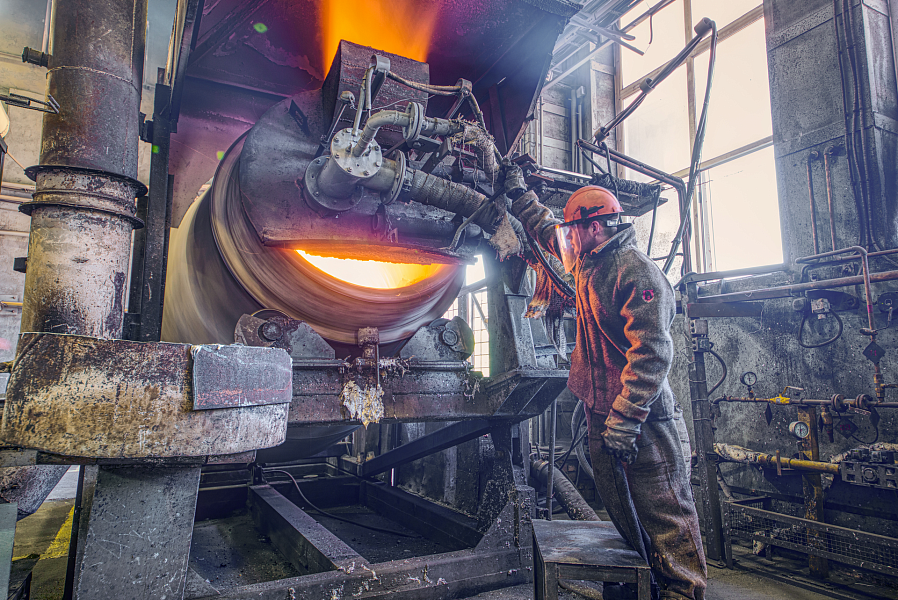


The Ecomet facility serves as a prime example of the industrial-scale use of secondary aluminum. Every year, the company processes between 16,000 and 18,000 tons of aluminum scrap and waste.
Aluminum has a high potential for reuse and can be cycled back into production multiple times without losing its key properties. According to industry data, up to 75% of all aluminum ever produced is still in use today. This is why collecting and recycling aluminum scrap is a critical component of developing a circular economy.
"Melting secondary aluminum requires significantly less electricity compared to producing primary metal from ore – energy savings amount to 90 – 95%. On an enterprise scale, the annual reduction in energy consumption reaches hundreds of millions of kilowatt-hours, which cuts greenhouse gas emissions and aligns with the goals of low-carbon metallurgy," explains Anton Popov, CEO of Ecomet LLC.
Secondary aluminum alloys – used on their own or blended with primary aluminum – are widely employed in the production of internal combustion engines. This is a long-established industry practice rather than an experimental development. Cast secondary alloys from the aluminum-silicon-copper system, produced at Ecomet, are used to manufacture engine components such as cylinder blocks, cylinder heads, intake manifolds, oil pans, engine covers, and other cast housing parts.
The service life of engine components cast from secondary aluminum alloys – including those with added primary aluminum – ranges from 250,000 to 400,000 kilometers, depending on engine design and operating conditions. When casting and heat treatment technologies are strictly followed, the durability difference compared to parts made from primary aluminum does not exceed 5%. Industry statistics show no systemic failures attributed to the secondary origin of the metal.
Developing these types of production chains supports the objectives of the "Circular Economy" national project, which aims to transform industrial and consumer waste into secondary raw materials, maximize their return to economic circulation, and conserve natural resources. The Recyclers Registry is a key tool of the Extended Producer Responsibility (EPR) reform. It is designed to eliminate "gray" reporting schemes by ensuring that waste is actually recycled rather than sent to landfills. Currently, the registry includes more than 200 companies, among them Ecomet LLC.